Write the decision rule before starting a destination A/B test
Define the alternatives, the destination outcome and the stopping rule before splitting traffic. This brief separates route allocation from evidence that one page performs better.
Two onboarding pages are ready, and the team wants the short link to choose between them. Without a written brief, the test can finish as soon as one page happens to have more clicks. That result confuses allocation with success: sending more traffic to a page is not evidence that the page helped more people complete setup.
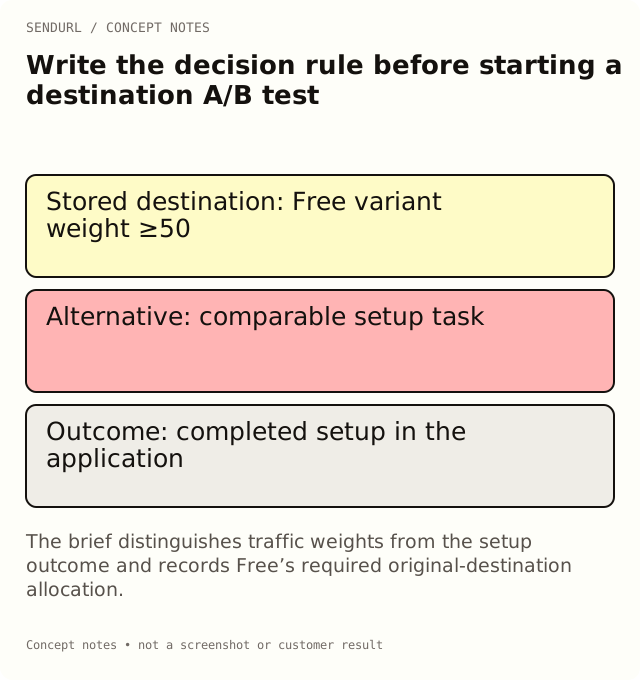
Describe the change the visitor will experience
An illustrative test compares a checklist-first setup page with a video-first page. Both must serve the same intended task and audience. A different offer, unsupported device or restricted login path can turn the exercise into a comparison of different journeys rather than the presentation change you meant to test.
Question and audience:
Current stored destination:
Variant A and its visitor promise:
Variant B and its visitor promise:
Weights and reason for this allocation:
Destination-system outcome definition:
How outcome evidence will be connected to each variant:
Observation window and timezone:
Stopping/continuation rule:
Known exclusions and device behavior:
What happens if evidence is inconclusive:
Owner who can approve the final destination:
Check the plan rules before allocation
Free allows one running A/B test with two variants. It must retain the link’s stored destination as a variant receiving at least half the traffic. Paid plans allow unlimited tests with up to four variants. Use the current controls and plan comparison, rather than assuming a free experiment can replace every visitor’s original route.
“Pick winner” is not a bypass for destination-edit restrictions. A selection that changes the stored destination requires Pro+. Decide who can make that change before the team promises an immediate rollout.
Walk through a small illustrative result
Suppose A receives 60 recorded requests and B receives 40 during a short observation window. That is not automatically a 60:40 preference. Allocation weights, sticky browsers, small samples and mobile targets can affect where requests go. Record the variant’s real outcome in the system that measures setup, with its attribution limits.
Do not keep changing weights until the desired result appears. If a page is broken, document the incident and the operational intervention. A repaired journey may need a new observation window rather than a single blended result.
Approve an honest ending
An inconclusive result is a valid ending when the evidence does not support the planned decision. Keep both the brief and the measured outcome. They explain what was tested more clearly than a “winner” screenshot by itself.
Create the saved test link in SendURL after the alternatives and measurement are ready. For the distinction between manual per-variant links and a destination split, read A/B Test With Short Links: One Link per Variant.
Frequently asked questions
Are variant requests the conversion outcome?
No. They describe allocation through the route. Define the meaningful destination outcome in the system that records it.
Can Free send all test traffic away from the stored destination?
No. The stored destination must remain a variant with weight at least 50 on Free.
What if the alternate page looks ahead after one afternoon?
Apply the written observation and stopping rule. A convenient early lead is not a substitute for adequate evidence.
Start tracking links free.
Create your first short link with click analytics in seconds. No credit card, no sign-up to start.