What Top social can and cannot tell you about distribution
Top social summarizes requests with recognized social referrer context in the selected scope. It is not a complete inventory of every request that originated in a social app; missing referrers and copied routes limit that interpretation.
A creator publishes a campaign link on a social profile, but the owner sees activity outside the social group. The immediate assumption is that tracking failed. First ask what evidence the request actually supplied and whether the same route was reused elsewhere.
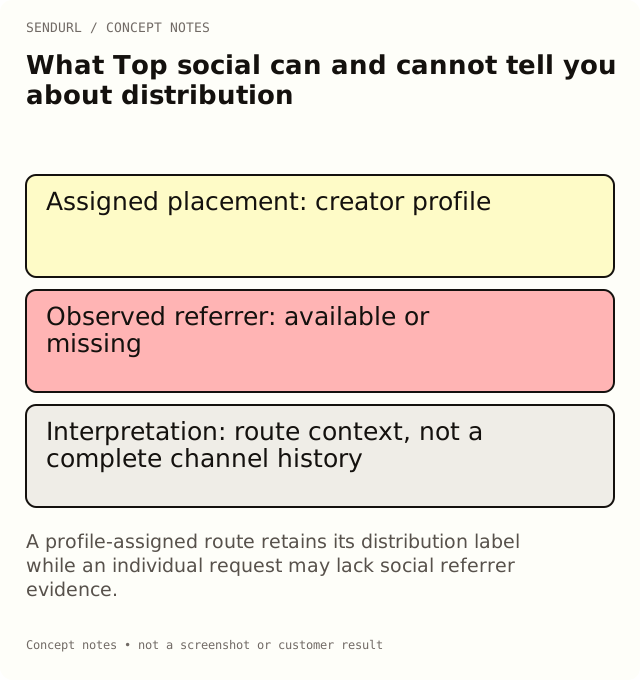
A referrer is request context, not a guaranteed channel label
A request may carry referrer information indicating an earlier web context. It may also arrive without usable information. An app, privacy behavior or a copied link can change what the receiving service observes. The route does not automatically know the visitor’s complete earlier journey.
SendURL’s social grouping uses recognized referrer context. That is narrower than a promise to identify every platform that ever distributed the address. Keep the report’s definition beside its title so a useful subset does not become a claim about all social-origin traffic.
Missing does not mean deliberately typed
When no referrer is available, a direct-style classification does not prove that the person typed the address or used a bookmark. The address may have come from an app or message that did not supply the expected context.
Do not replace missing evidence with a confident story about the reader. A request record can tell you what was observed, not every reason why a field is absent. If the business needs placement attribution, establish useful distribution context before publishing rather than hoping the referrer will reconstruct it later.
A separate route preserves the placement you assigned
For an illustrative launch, create distinct saved links for the creator’s profile, the brand’s newsletter and a partner post. The internal titles and register preserve which route you gave to each placement. Missing referrer information does not erase that owner-assigned context.
It still does not establish a named person or an exclusive channel. A creator’s profile address can be copied into a group chat. The route then continues to describe the address originally assigned to the profile, not a verified claim that every later request came directly from that profile.
Keep QR marking separate from inferred social origin
SendURL marks a QR request through the presence of ?q on its QR route. If that marked address is copied into a social message, the marker is still present. It does not prove that the particular request came from a physical camera scan.
Use the intended ordinary or QR address consistently in each distribution task. Do not strip or add markers casually while collecting evidence, and do not reinterpret a marked request as a unique person. The saved route, the referrer and the marker provide different pieces of context.
Work through an apparent mismatch
Suppose a creator reports that a profile link is live and the corresponding saved route records requests. The social card shows fewer observations than the route’s total. That difference does not prove the creator is wrong or that the request count is broken.
Check the actual profile placement, the address distributed, the scope and the time window. Then inspect available referrer context and known forwarding or tests. If the evidence cannot explain every request, report the limitation rather than inventing a percentage of “hidden social clicks.” The example is conceptual, not a measured campaign benchmark.
UTM parameters answer another question
UTMs on the stored destination can help the website analytics system interpret campaign context under its own rules. They do not cause a missing HTTP referrer to appear in SendURL. Source, medium and campaign grouping in SendURL also reads the current stored destination rather than a per-click historical parameter ledger.
Keep these mechanisms distinct when troubleshooting. Put UTMs on the approved destination before creating the link. Do not append them to the public short route and assume they will be forwarded or repair every attribution gap.
Compare social platforms with appropriate outcomes
A platform’s impressions or engagement count is not the same event as a request through your route. Define any click-through ratio with an appropriate denominator and a consistent window. A combined platform engagement metric should not silently become an outbound click count.
For purchases or registrations, use the destination system’s completion evidence. The social grouping can help explain observed distribution context, but it is not a native revenue attribution system or a list of people who read the resource.
Build a report that can be reproduced
Record the selected links or folder, dates and timezone. Note known team tests and the actual distributed address. Keep an explicit “not established” field when the report cannot identify the earlier channel behind a request.
Free’s dashboard history is seven days, with longer histories on paid tiers. Compare the reporting windows and advanced measures before scheduling a recurring review. Create maintained placement links in SendURL when a clearer inventory will help the reporting question.
The social media placement guide and Bot Clicks and Link Previews explain the broader distribution and automated-request context.
Frequently asked questions
Does Direct prove somebody typed the address?
No. It can reflect absent referrer information. Do not infer the full earlier journey from that classification alone.
Will one shared link identify every social placement automatically?
No. Referrers can be absent, and addresses can be copied. Use separate routes where placement context matters.
Can UTMs restore a missing referrer?
They supply campaign context to supported reporting systems; they do not make an absent HTTP referrer appear.
Does a marked QR address in a chat prove a camera scan?
No. The marker remains part of the supplied route even when someone copies it into another surface.
Start tracking links free.
Create your first short link with click analytics in seconds. No credit card, no sign-up to start.