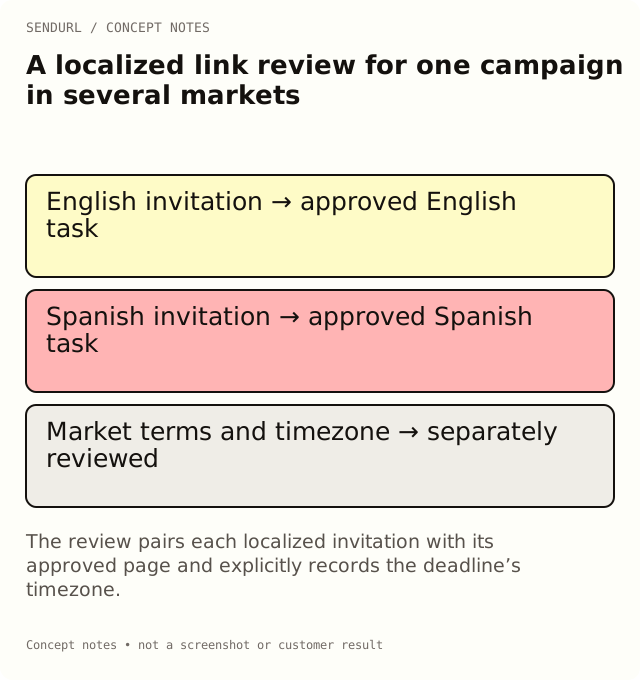
A localized link review for one campaign in several markets
Check language, offer, timezone and fallback at the destination for each market. Approximate click geography is not evidence that the correct localized page was served.
A campaign is translated into two languages, but both buttons still open the original offer page. The copy review passed because the text was correct; the route review was never assigned. A market-by-market link sheet makes the destination part of localization rather than a final technical detail.
State the intended reader experience
For an illustrative English and Spanish product guide, decide whether each placement opens a language-specific page or a page with a clear language choice. Neither approach is automatically right. The important thing is that the invitation, the page and the fallback make sense together.
market_and_language,placement,promised_resource,approved_destination,offer_or_currency,deadline_timezone,reviewer
[market A / English],Email CTA,Setup guide,[English page],[applicable terms],[explicit zone],Language owner A
[market B / Spanish],Email CTA,Guía de instalación,[Spanish page],[applicable terms],[explicit zone],Language owner B
Follow the wrong-language example
Send the final localized message through the intended distribution process. Follow its button in a representative browser context, then verify the visible language and the task. A URL containing /es/ is not enough if the page redirects back to English or requires a region-specific login that the audience does not have.
Check currency and offer dates separately from language. Translation does not establish market eligibility or the applicable commercial terms. Ask the appropriate owner to approve those details rather than deriving them from a country label in analytics.
Avoid inventing automatic geographic routing
SendURL’s approximate city and country reports describe recorded request context. They do not, by themselves, prove that a particular language or regional offer was delivered. Do not advertise the short link as a native country-routing engine unless the actual configured journey provides that behavior.
Use distinct saved routes for the market placements when the review needs that distribution context. Keep UTMs on the approved destinations, with a naming rule the reporting team understands. A geographic label in a link title is internal context, not verified reader location.
Approve the fallback and the deadline
Open the route with a new-reader session as well as the reviewer’s familiar browser. Verify what happens when the page cannot infer a preference, and state the offer deadline with its intended timezone. Record any redirection or language-selection behavior that could change the result.
If the team plans to retarget a route after a translation correction, that destination edit requires Pro+. Review pricing and history windows before scheduling reporting across markets. Save the approved market routes in SendURL only after the destination owners sign off.
Measurement reference
Use Click Country and Device Data to Target Campaigns explains what the location and device evidence can support; the localized-page test remains a separate observation.
Frequently asked questions
Does a click from a country prove that its local-language page loaded?
No. Verify the actual destination behavior. Request geography and delivered language are different observations.
Should the language code be put in every UTM value?
Use a documented naming rule only where the distinction supports reporting. Do not duplicate labels without a defined purpose.
Can one translated message prove market compliance?
No. Offer eligibility, sending requirements and commercial terms need the responsible owners’ separate review.
Start tracking links free.
Create your first short link with click analytics in seconds. No credit card, no sign-up to start.