A campaign naming dictionary with definitions, not just approved spellings
Define the meaning and owner of campaign labels before distributing them. A shared spelling list is useful only when everybody agrees what each value represents.
Two teams can use the same campaign label and mean different launches. They can also use different spellings for the same launch and split a report unnecessarily. A naming dictionary handles both problems: the allowed value has a definition, an owner and an example destination.
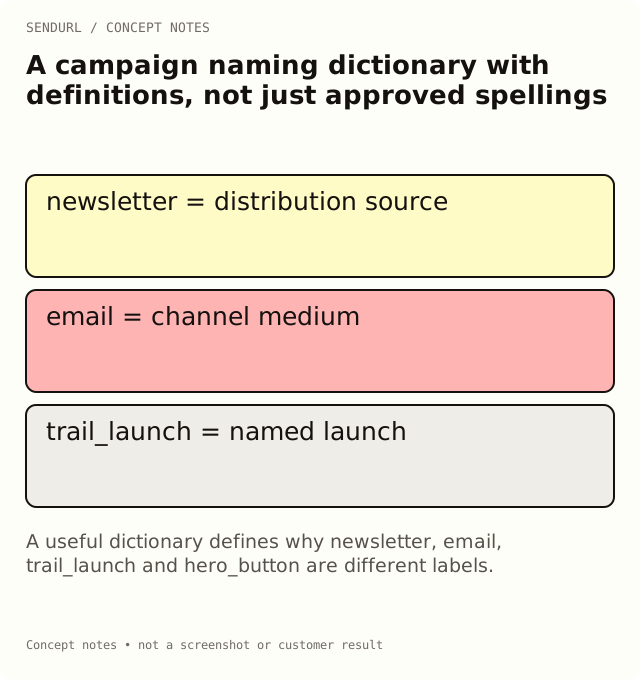
Define values at the level of the decision
Consider an illustrative spring trail-shoe campaign. The campaign value identifies that launch. The source identifies the distribution source, while a placement detail can distinguish the main email button from its footer. These are separate jobs, even if your sheet places them beside each other.
parameter,approved_value,meaning,owner,example_context,retire_when
utm_source,newsletter,Owned newsletter distribution,Email lead,Monthly product message,Source changes
utm_medium,email,Email channel classification,Analytics lead,Newsletter CTA,Channel rules change
utm_campaign,trail_launch,Spring trail-shoe launch,Launch lead,All approved launch destinations,Launch archive complete
utm_content,hero_button,Main email hero CTA,Email lead,Hero versus footer review,Placement design changes
Resolve the ambiguous launch label
If a wholesale team wants to use trail_launch for a later partner program, ask whether reports need to separate it from the consumer launch. A distinct value may be appropriate. Do not automatically reuse a familiar string because it passes a formatting rule.
Write an example destination next to the dictionary when reviewing a campaign. Check the query after the landing page loads. Parameters belong on the stored destination before you create its short link; appending them to an existing short URL does not make SendURL forward them to that destination.
Approve changes without rewriting history
Keep an amendment note with the old meaning, the new value and the first distribution time. Editing an existing destination is Pro+, and SendURL’s UTM grouping reads each link’s current stored destination. A label change can therefore change how older requests are grouped in that view; it is not a per-click historical UTM ledger.
Use the destination analytics system when you need its session attribution, and retain the distributed-link register when you need evidence of an earlier campaign mapping. The dictionary explains naming intent; it cannot reconstruct missing history.
Test the smallest useful example
Use the UTM builder with the four sample values and a public demonstration page you control. Copy the destination, inspect its spelling, then compare the team’s expected meaning with the dictionary. The example is approved when both the address and the definition are right, not merely when the syntax validates.
Open an account to save the reviewed campaign links once their destinations are settled. For current history windows and advanced UTM statistics, consult SendURL pricing rather than embedding an assumed entitlement in the dictionary.
Naming and attribution references
UTM Naming Convention: Rules, Allowed Values and a Template covers the broader naming system. UTM Parameters: GA4 Rules, 25 Examples and Templates distinguishes the parameter roles.
Frequently asked questions
Should I normalize old distributed URLs automatically?
Keep the original evidence first. A cleaner label can still change the interpretation of a report or an existing route.
Does utm_content have a SendURL statistics breakdown?
No. SendURL’s UTM grouping uses source, medium or campaign from the current destination. Keep content-level analysis in the system that supports it.
Who approves a new value?
Name the person responsible for its business meaning, with analytics review where channel classification is involved.
See where your clicks come from.
Every short link tracks clicks by country, device, browser and referrer, on the Free plan too. No credit card, no sign-up to start.