What an approximate unique visitor means in link analytics
SendURL's Unique visitors is an approximate count of distinct visitors within the selected reporting scope, It is useful context, not a count of verified people or named customers.
A campaign link has many recorded requests but a smaller unique-visitor estimate. The difference can be useful, but it does not mean that you have discovered exactly how many people returned. Before describing repeat visitors or customer interest, understand what the estimate actually distinguishes.
The unit is an estimate, not a person
SendURL’s Unique visitors is an approximate count of distinct visitors in the selected scope. Several requests can count as one visitor, and one visitor can count more than once. The report should be read with its link or folder selection, dates and timezone, because those settings define the population being counted.
The label is an approximation for a reason. One person can make requests through different networks, and several people can share one connection. You do not need to know a visitor’s private network setup to preserve that uncertainty in a report.
A small example you can reason through
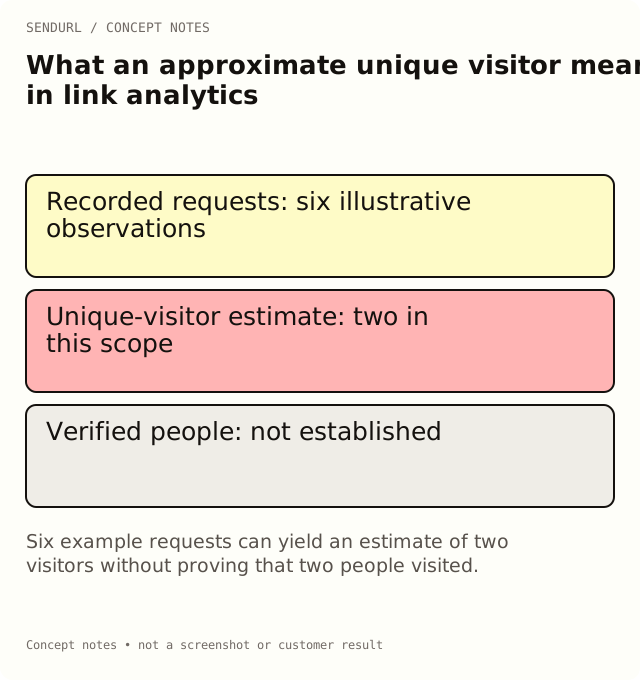
Imagine six recorded requests in an illustrative dataset. Suppose the estimate for that scope reads two visitors. The dataset does not tell you whether there were two people, a shared office and a household, or one person who changed networks.
The total request count still describes six observations, while the estimate describes a smaller number of distinct visitors. Do not invent identities to make the two numbers agree.
These are explanatory examples, not observed SendURL campaign results. They demonstrate the definition without making a claim about the typical gap between requests and people.
Why shared networks can lower the estimate
An office, school or another shared connection may present one network identity for several readers. If several people follow your route through that context, the unique estimate need not distinguish each person. Describing the result as “only one customer” would overstate the information available.
The practical response is not to infer a hidden headcount from the estimate. Report the observed unit, and use an appropriately authorized destination system when the business question concerns authenticated users, registrations or orders. Keep that system’s own identity and collection limitations visible too.
Why changing networks can raise it
A person may open a resource on one connection and later use another. The link report does not automatically know that those observations belong to the same human. An increase in the estimate therefore does not establish an equal increase in people reached.
This matters when somebody asks whether a reminder attracted a new audience. Separate placement links can preserve distribution context, but they do not solve human identity. A forwarded link and an automated request can add further ambiguity.
Scope the count before interpreting it
To review a saved resource, select the relevant link in Analytics, check the date range and confirm the timezone. Note whether you are looking at one link or a wider folder. A unique estimate for a combined scope is not obtained by naively adding each link’s separate estimate: the same visitor may appear under more than one route.
Keep a reference to the exact report used. If the team changes the scope between weekly screenshots, an apparent movement in the estimate can be a reporting change rather than an audience change. State the denominator when calculating any ratio involving it.
A locked value is not a zero
Approximate unique visitors are part of Pro+ advanced analytics. Free can show that the measure is locked or unavailable; that is different from observing no visitors. A report that replaces a locked value with zero will tell a false story about the campaign.
Compare advanced analytics and history windows before promising a recurring unique-visitor report. A paid feature supplies the estimate under its definition; payment does not turn it into person-level attribution or a named-reader log.
Use the estimate for a bounded question
A sensible question is whether request activity and the unique-visitor estimate moved differently in a consistently scoped period. That can motivate a review of distribution, repeated requests or automated retrieval. It cannot, on its own, establish why the change happened.
If the important question is completed onboarding, use the application’s completed-onboarding event. If it is orders, use the commerce definition. Keep the link estimate as earlier-stage route evidence rather than replacing the business outcome with a more convenient metric.
Create an account for the campaign’s maintained routes when separate placements and consistent reporting would help that investigation. The value comes from a clear question and reproducible scope, not from assigning more certainty to a number than its method supports.
Product and measurement references
What SendURL Records for Every Click describes request observations. Can You See Who Clicked Your Link? explains the identity boundary.
Frequently asked questions
Can one person count as more than one approximate unique visitor?
Yes. A person who switches connections or devices can be counted more than once. The estimate does not merge them into a human identity.
Can several people contribute one distinct address?
Yes. Readers behind one shared connection, such as an office network, can be counted as one.
Why is the Free value unavailable rather than zero?
Unique visitors are a Pro+ advanced measure. A locked value is an entitlement condition, not a measured absence of activity.
Can I add unique estimates across links?
Do not assume the sum is a deduplicated combined estimate. The same visitor can appear under several links.
Start tracking links free.
Create your first short link with click analytics in seconds. No credit card, no sign-up to start.