Analytics history is not the same as deleting old click records
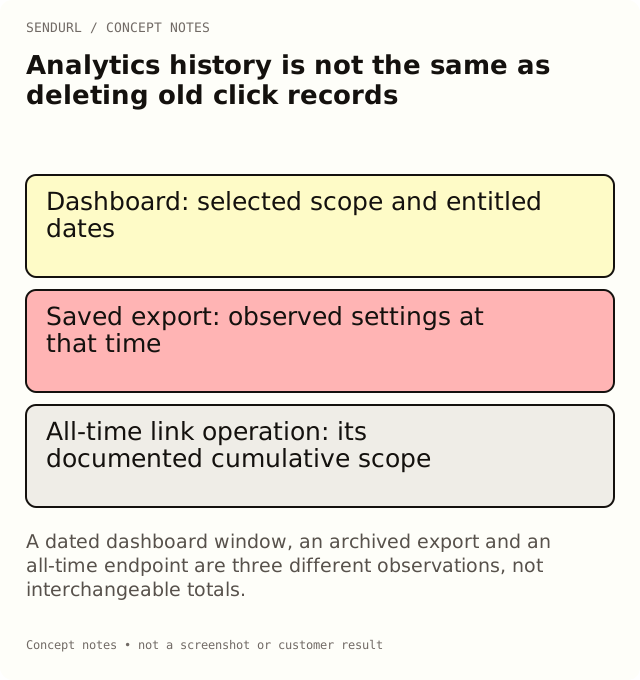
A dashboard history entitlement limits the available analytics window. It does not by itself mean that every older click record has been deleted, and an all-time link endpoint is not the same report as a date-scoped dashboard view.
A campaign owner opens an older date range, finds it unavailable on the current plan and concludes that the earlier activity disappeared. Another teammate quotes an all-time link total as proof that the dashboard should show the same number for last week. Both interpretations mix different scopes.
Start with the report being requested
The dashboard analytics view has a selected organization context, folder or link scope, dates and timezone. Its history window follows the current plan. Free’s catalogue history is seven days, while Pro’s is 90 days; higher tiers provide their own longer windows.
The backend implements the history boundary using local today and the configured number of days before it in the viewer’s timezone. This is a calendar-based rule, not a promise that every display is an identical rolling number of elapsed hours. Check the actual date controls and timezone when reproducing an observation.
Unavailable history is not a measured zero
A range outside the available entitlement is not evidence that no requests occurred then. Do not fill that interval with zero in a report merely because the current view cannot show it. Record the limitation or choose a supported window.
Likewise, a locked advanced measure on Free is not zero. Approximate unique visitors, cities and UTM statistics have their own Pro+ boundary. A report can be within the available date range and still include a measure the plan does not expose.
Some link operations are all-time observations
Documented per-link statistics and click operations have their own contract and can cover all-time link activity. They are not interchangeable with the console’s date-scoped analytics endpoints. Read the operation’s definition before joining its output to a dashboard screenshot.
An all-time total can include requests outside the selected campaign period. That does not make it an error or a substitute denominator. The useful comparison matches the question’s scope rather than selecting whichever available number is larger or easier to retrieve.
Work through an older campaign review
Imagine a team that wants to review a launch from an earlier period while using Free today. It may have a dated export or report saved during the campaign, and the link may still have an all-time total. Those are useful records with different meanings.
The saved export can describe what was observed at its recorded time and settings. The all-time total describes its supported cumulative scope. Neither should be relabelled as a newly generated date-filtered report if that exact older dashboard window is unavailable. State the evidence you actually have and what remains unmeasured.
A history upgrade is a capability decision
Pro provides 90 days of catalogue history, Premium 180, Team 365 and Enterprise a long catalogue window marketed as Lifetime. Pricing lists the current history offering. Choose around the review cadence and the features needed, rather than assuming every paid tier has the same reporting period.
Do not promise that a plan change creates missing destination conversions or reconstructs a historical placement mapping that was never recorded. History access and evidence collection are separate issues. SendURL’s UTM grouping, for example, reads the link’s current stored destination rather than archived UTM values on every click.
Preserve the original observation context
A useful report archive includes the export time, selected scope, date boundaries, timezone and metric definitions. Keep the earlier destination mapping where a later edit would affect interpretation. A screenshot without those settings can be difficult to reproduce even while the underlying activity remains available.
This does not require saving every possible field indefinitely. Retain the records appropriate for the organization’s reporting and access process, and keep private destinations or credentials out of broadly shared copies. The product’s history entitlement is not a complete data-governance policy for your organization.
Distinguish a deleted link from an older window
Deletion is another lifecycle action. A deleted link is removed from ordinary live-link views and its route stops working under the supported behavior, while its slug remains reserved and it still counts toward link quota. That is not the same condition as a live link whose older dashboard range is outside the plan’s history.
Before diagnosing disappearance, identify the actual route, ownership, active/deleted state, endpoint and selected report settings. A folder-scoped key can also see a different inventory from a console session. Do not infer deletion solely from one unavailable report.
Plan reviews before distribution
Schedule an early review for a short campaign and a later outcome review in the system that records the business event. If the campaign needs a longer scoped link history, choose the suitable plan or an approved reporting process before the expected review date.
Create maintained campaign routes in a SendURL account with an owner for that reporting plan. Clicks Over Time explains date-bucket reading, while the SendURL REST API reference distinguishes supported link operations from session-only dashboard analytics.
Frequently asked questions
Does Free’s unavailable older range mean all old records were deleted?
Not established by that entitlement. Identify the report and operation before making a deletion claim.
Can an all-time link count stand in for last week’s campaign count?
No. It is a different scope. Use a matching dated observation for that question.
Is locked city data the same as zero cities?
No. It is unavailable under the current feature entitlement, not an observed absence.
Will a longer history reconstruct old destination parameters?
Not automatically. Preserve historical mappings separately; SendURL’s UTM grouping reads the current stored destination.
See where your clicks come from.
Every short link tracks clicks by country, device, browser and referrer, on the Free plan too. No credit card, no sign-up to start.